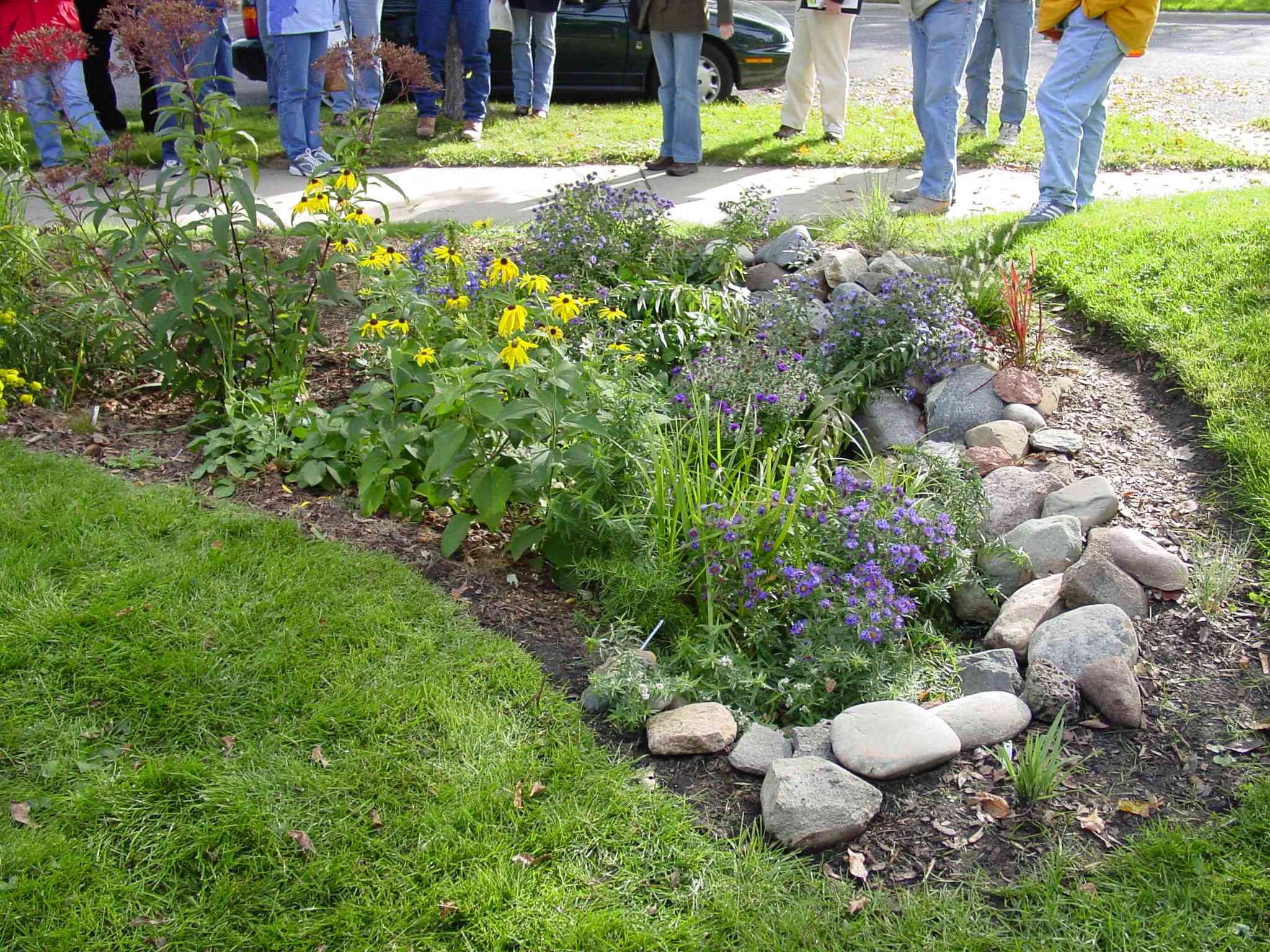
Recently, we've designed a few sites utilizing rainwater gardens.
These are slight depressions in the site's topography that are planted with vegetation. Rain and stormwater runoff naturally drain into the basins, creating an attractive low-maintenance landscape feature.
 |
| Example of a rainwater garden |
Here's a visual that might explain the idea better:

You can use a mix of wildflowers, grasses, shrubs, and trees in rainwater gardens. When planting, place seedlings 1' apart, with more flood tolerant species toward the bottom of the basin and drought tolerant species toward the top. Include at least 40% grasses to provide dense root masses to help with erosion.
Some excellent species to use in rainwater gardens in the Black Hills region include:
 |
| Prairie smoke Geum triflorum |
 |
| Purple prairieclover Dalea purpurea |
 |
| Prairie dropseed Sporobolus heterolepsis |
When locating where you want to put your rainwater garden, make sure that you're placing it where the site's existing runoff flows to. Also, be sure to locate it at least 15' away from structures.

Rainwater gardens are an effective way to utilize natural runoff, avoiding the need for expensive irrigation systems. These features are actually part of a larger family of sustainable methods called rainwater harvesting.
To learn more about this technique, I suggest Brad Lancaster's book Rainwater Harvesting for Drylands and Beyond as an excellent resource.
as an excellent resource. Cheers to free water!