Showing posts with label water. Show all posts

Monday, October 24, 2011

Lessen Impact Challenge: Water Week

It's Water Week here at FourFront Design and the final days of the Lessen Impact Challenge.

This morning, Steve set up a water sampling taste test with four water sources to compare: A) filtered water from the office, B) bottled water (Smart Water brand), C) water from Steve's well at home, and D) regular City water from the tap.

Here are the results:


Steve's well water received the most votes for the best tasting water, while the City water and filtered water received the most votes for the worst tasting water. There seemed to be a wide range of opinions, with some of the sources receiving similar amounts of votes for both the best and worst tasting water. Although this test wasn't necessarily scientific, results show that when buying bottled water, you don't necessarily get what you pay for.

We also had a great discussion about water usage in our community, and were given information about the City's rebate program for low water use toilets and high-efficiency washing machines.


Jeremy and Curt discussing the balance and finish of their last sampling of water.

FourFront employees, this is the last week of the challenge, so make it count!


Tuesday, August 23, 2011

Let it Rain!

Recently, we've designed a few sites utilizing rainwater gardens.

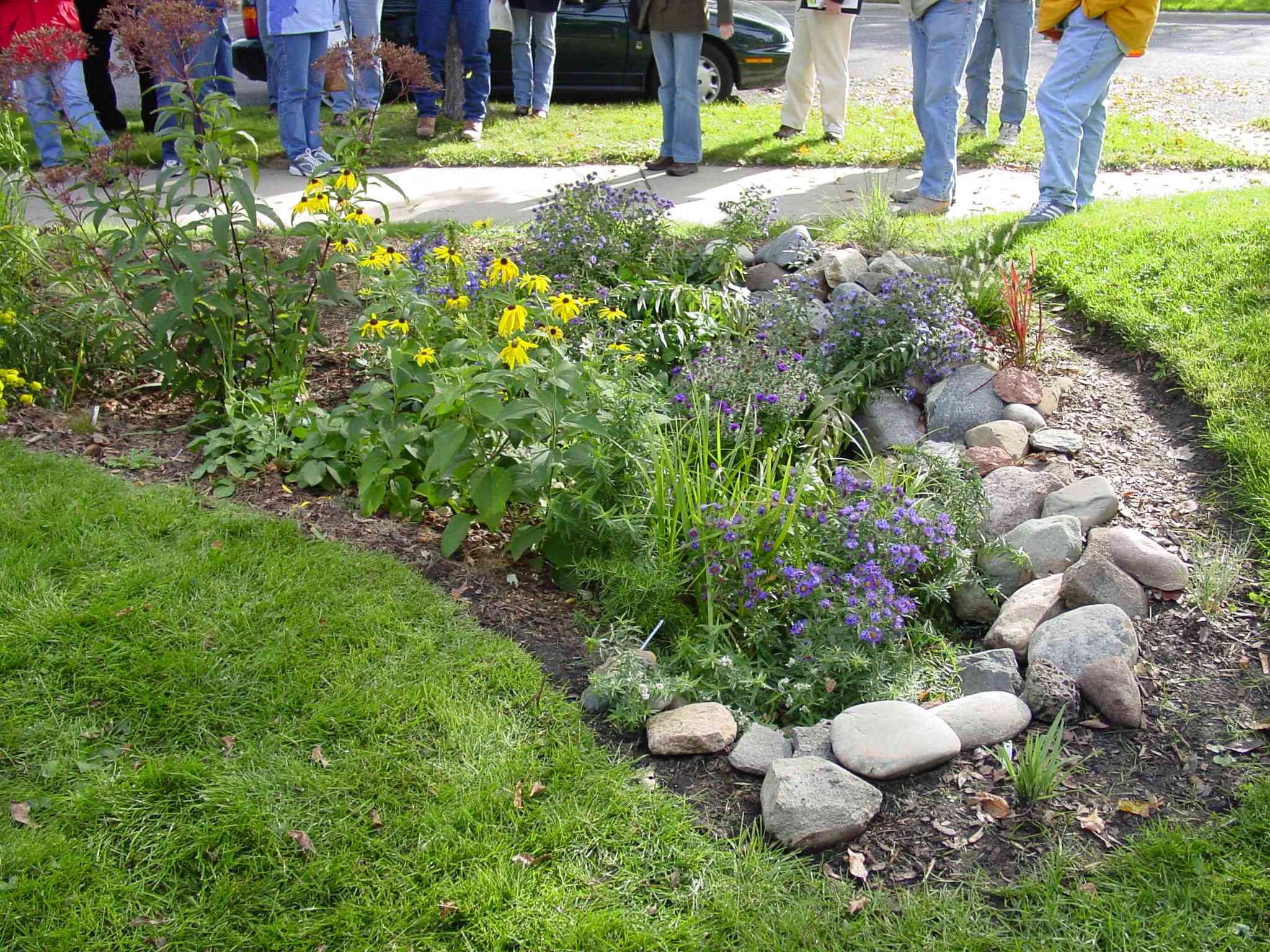
These are slight depressions in the site's topography that are planted with vegetation. Rain and stormwater runoff naturally drain into the basins, creating an attractive low-maintenance landscape feature. 

Example of a rainwater garden

Here's a visual that might explain the idea better:


You can use a mix of wildflowers, grasses, shrubs, and trees in rainwater gardens. When planting, place seedlings 1' apart, with more flood tolerant species toward the bottom of the basin and drought tolerant species toward the top. Include at least 40% grasses to provide dense root masses to help with erosion. 

Some excellent species to use in rainwater gardens in the Black Hills region include:

Prairie smoke
Geum triflorum
Purple prairieclover
Dalea purpurea

Prairie dropseed
Sporobolus heterolepsis

When locating where you want to put your rainwater garden, make sure that you're placing it where the site's existing runoff flows to. Also, be sure to locate it at least 15' away from structures. 


Rainwater gardens are an effective way to utilize natural runoff, avoiding the need for expensive irrigation systems. These features are actually part of a larger family of sustainable methods called rainwater harvesting.

To learn more about this technique, I suggest Brad Lancaster's book Rainwater Harvesting for Drylands and Beyond as an excellent resource. 

Cheers to free water!

Wednesday, August 10, 2011

So what is Grey Water and We Can Water Our Gardens with it?


I’ve discovered that the water created after washing our laundry is “grey water” and guess what?  You can water your gardens with it!!!!  Of course this comes with some caveats.  You need to use eco-friendly detergents, no bleach, and use caution with fabric softeners.  A good rule of thumb is that most products made for septic systems are safe for grey watering.  Another note:  the laundry itself can’t contain “harmful” products being washed off it.  I probably wouldn't take junior's dirty diapers (should you be brave enough to use cloth diapers) and recycle that water. 


Actually it’s been discovered that dirty laundry water can be a treat for plant life.  Some of the organic materials found in laundry waste water can actually supply extra nutrients they ordinarily wouldn’t get.  Many detergents contain nitrogen and phosphates which help with plant growth. Quite often, grey water users report an increase in growth and overall positive appearance in the garden. 

How do you go about converting to grey watering?  It can be as simple as adding a hose to drain the laundry waste water from the machine to your garden.  You can set up a dual system which can be turned on to divert grey water to sewer when needed for those times the water in the wash could be harmful to the plants.  Also, using your judgment on which plants you want to use grey water on is always a very personal choice.  Often people will use grey water on everything but vegetables, as they are edible.  Should you decide to go “grey”, there are many useful websites with plans for enabling this.  Give it a thought, and maybe a try.  What do you have to lose?  What do you have to save?  Water!!!


-Laura